
Cloud Enablement for Enterprise Applications
By Nikhil Shintre Table of Content Models for Cloud Enablement Comparing the Enablement Models How to Choose Between the Models Over the last decade or so, cloud has evolved as a preferred IT deployment model. Popularity of cloud can be gauged from the fact that majority of the enterprise IT providers are now having some kind of cloud offering, and most of the startup launched in this period are cloud native. As cloud adoption becomes common practice and the benefits are well established, a larger number of enterprises move their current application stacks to cloud. As part of this shift, they also expect the Independent Software Vendors (ISVs) to enable and optimize their software for cloud. However, for the ISVs this require much deeper considerations like commercial models for cloud enablement, acceptance by the existing customers and the impact on acquisition / onboarding of new customers. Models for Cloud Enablement From our experience, we see three possible models for cloud enablement – Cloud enablement in customer setup, Cloud enablement with the setup managed by ISV, and a full fledge multi-tenant SaaS setup managed by ISV. From the ISV perspective, this is easiest to implement by adopting certain services like scaling, storage and monitoring in the software. However, since each customer could have their own cloud preference, it is advisable not to commit too much to a specific cloud service. In this model ISV handles complete deployment, monitoring and maintenance. This gives ISV flexibility to choose the cloud provider and plan the cloud enablement and optimization. This requires major restructuring of the application to ensure software level separation of tenant specific data and user access. Since this is software level separation, it needs to be carefully maintained during the development. Comparing the Enablement Models Each of the above three models has its pros and cons in terms of effort for cloud enablement, maintenance of the setup, and licensing / pricing. These aspects can be compared as below. In Customer Cloud Single Tenant SaaS Multi-Tenant SaaS Enablement efforts Minimal Minimal Sizeable Cost of Infrastructure Directly paid by customer Can be charged to customer at actuals Must be bundled in subscription price Licensing Model Can continue with existing mechanism Can continue with existing mechanism Need to implement subscription model License Upgrade / Downgrade Very difficult to implement Can enable upgrade / downgrade Easy to upgrade / downgrade Upgrade to New Versions Customer decides on upgrade schedule Flexibility to delay for specific cases All customers get upgraded at once Upgrade Frequency Must be less Can be moderate Frequent upgrades possible Onboarding Efforts Same as existing Reduced efforts Minimal efforts Availability monitoring By customer By ISV By ISV How to Choose Between the Models Each of the three models serve a particular situation, but it is difficult to define specific rules around it. Instead, as a general guideline following aspects can be considered – As a final word, the cloud enablement model must ensure smooth transition for existing customers, and ease of acquiring / onboarding new customers. So it is important to involve the product management, engineering and the customer support functions in any decision. References-https://docs.microsoft.com/en-us/azure/azure-sql/database/saas-tenancy-app-design-patternshttps://aws.amazon.com/blogs/apn/architecting-successful-saas-understanding-cloud-based-software-as-a-service-models/https://cloud.google.com/kubernetes-engine/docs/best-practices/enterprise-multitenancy
Read More
Popular Approaches to Software Outsourcing Models
A survey conducted by Deloitte in 2020 reports an increase from 20% to 50% in the number of firms resorting to outsourcing, a significant chunk of which fall into R&D. It is evident that software outsourcing is an integral norm among the tech and manufacturing industry. Outsourcing can be a valuable tool to boost ongoing innovation, accelerate product releases, and sustainable business success with the right and systematic approach. However, with a hasty and unorganized process, outsourcing can be a business mess up, which is pretty tricky & hefty to manage. A big concern for companies looking to outsource is getting the right expertise to get the job done. There is a talent shortage globally, and since every company looks forward to profitable business returns, finding the right talent is crucial. In fact, the CIO Agenda Reports published in 2017 by Gartner identifies talent as the “single biggest issue standing in the way of CIOs achieving their objectives.” In fact, the CIO Agenda Reports published in 2017 by Gartner identifies talent as the “single biggest issue standing in the way of CIOs achieving their objectives.” Now it is worth starting with the basics and understanding them. Here we are talking about the Service Models. A company can choose from different software outsourcing models for software development, product testing, or maintenance of a software product. They are as follows: Staff Augmentation Staff augmentation is a commonly used and often applied software outsourcing model. The client-side evaluates the existing workforce and decides which skills are required and a lack of skilled professionals. The task of sourcing expert professionals depends upon an outsourcing firm. Besides that, the outsourcing group must monitor proper allocation, staff leave balances, paid time offs, and the number of hours they spend working for a client project. The outsourcing team might be required to provide workspace, but that depends on the client-vendor agreement.The client-side controls aspects like project management, task allocation, distribution, team building, work assignments, hiring-firing, promotion of employees. The client-side can discharge anyone in case their performance is not up to the mark. Dedicated Team The dedicated team is somewhat different from staff augmentation. In the dedicated team model, the outsourcing partner provides an end-to-end team on a long-term basis. Since a dedicated team involves a group of professionals solely built to address a project pipeline, the responsibility rests upon the vendor partner to monitor people management, task allocation, attrition, micromanagement, etc. The outsourcing vendor must ensure the task status is on the right track and enact quality standards and efficient managers to take care of the same. The provider’s job is to chalk out the best process for the team and then ensure it is followed. The provider is in sync with the ongoing project, reports status, and suggests project management. Although the provider gets responsibility for internal projects and product decisions, the client usually wants to keep control and maintain surveillance over the entire product roadmap at a high level.Dedicated team model has some perks such as a predictable and defined budget, fully committed team members who have a thorough understanding of client requirements. A dedicated team is valuable, especially when the project scope is not strictly defined and requirements change based on circumstances. In such cases, the client always gets a team ready to act no matter what. Project-Based Outsourcing The third model, project-based outsourcing, is five folds away from the dedicated team approach. The client is most concerned about the result, not the methodology and means that go under it.The model emphasizes the end goal and the final product to be delivered, which the outsourcing provider must reach within a stipulated timeline. The client needs are defined, the time frame is established, and the rest depends on the partner to meet all the requirements. Project-based outsourcing is about the “what and when” factor rather than the “how and why” factor. With the widespread implementation of agile methodology in software development, the borders between dedicated teams and projects have overlapped. Choosing the suitable outsourcing model That first and foremost rule of software development outsourcing is – understanding what your actual needs are. If you are not clear about what you want, then your endeavor might fail. Once you have a clear end picture, you can go ahead, take the right direction, and implement it. In a nutshell, here are the conditions which should prompt you to go for either of the three outsourcing approaches: There are many factors to consider if we are looking for the best fit while avoiding the cons. Everything in the world has both pros and cons. All the three models of software outsourcing described above are just stages of increased responsibilities upon the service provider. The more you push the project towards the provider, the more capital you need to dish out. The staff augmentation model is mainly in need of your own doing, where you manage a team, allocate tasks, micro-manage, hire staff, fire teams, you dictate almost everything. If you wish to halt the project, staff augmentation is best suited for that. But the attrition and the project failures will be on you. You build something on your terms in staff augmentation.It is not the case in a dedicated model. You transfer a considerable amount of work to the provider. You need not worry about every aspect of the model but keep a hovering eye over what’s going on. The project’s finer details are on the provider, but your call is the last call on what you want. You can dictate sudden modifications in the mid-term owing to a dedicated model agreement, but the provider decides how to approach the issue and make it happen. If the project fails, the blame falls on both of you to consider this model quite seriously.The project-based approach completely takes off the burden of development and puts it on the provider. You lose control over the whole process; you can no longer influence the people management, you have no control over transparency,
Read More
Points to keep in mind when Outsourcing Software Development
IT software outsourcing and CAD software outsourcing are some of the largest industries in the 21st century. Software development outsourcing takes place for various reasons, ranging from requiring specialized software/professionals to creating a digital product or addressing a given task. A survey report indicates 57% of US start-ups have already outsourced their software development process. Regardless of cases, outsourcing IT & CAD software projects is a positive decision that accelerates and accomplishes a software development need. But there is some caution to this. Anything listed on the internet as software development service is not necessarily a perfect solution to your projects. There are various factors to look into, which makes finding a software development service an uphill task. To make it easier for you, let us have a walk of some of the best and widely advised practices to adhere to when outsourcing software development projects. Conduct background check The first step is to evaluate your requirements and look for various software development service providers. Prepare a list of candidates. It helps in assessing market costs for such services and allows you to fix a reference point. Once you have a fair idea, go ahead and shortlist the outsourcing firms that fit best to product requirements. Carry out extensive research on the shortlisted companies and sort your preferred ones out. You should assess them based on their proficiencies, average turnaround time, and client reviews/testaments. Remember, you are entering into a relationship with a 3rd party vendor, and you cannot leap of faith. It is essential to be wary of anything that concerns your project and requirements. Starting a business partnership is easy but getting out of it can be messy if things go downhill. Sort out your expenses in the correct order There is a factor called Value for the product. The cheapest of things out there doesn’t necessarily mean they are your best bet. Even with a fixed budget, it is recommended to look for quality and not just the cheapest outsourcing vendor available. It would be best if you struck a balance between your expectations and your expenses. Once this is figured out, the next step is to figure out the payment process and payments intervals. Businesses often come across situations that trigger payment hassles, so such possibilities must be considered and discussed beforehand. There is also a high chance of crossing the stipulated budget when outsourcing a project due to unforeseen necessities or unexpected circumstances. Therefore, it is best to leave some space in your budget for such circumstances. After all, better to be safe than sorry. Choose the most suitable pricing model The next step after arranging finances is looking into different types of pricing models. In this case, the pricing model is about the payment structure agreed with the vendor partner. Here are some commonly used pricing models: To find the best model that works for your project, sit down, and chalk up a plan of action with the 3rd party vendor partner. Ensure tight security of your project and product It is an important side many up-and-coming project owners might overlook. There are a few crucial security steps you should take to safeguard your product while dealing with third-party vendors: Please enquire about the security measures and protocols the vendor partner has set up and how they plan to work with your data. Generally, a good NDA (Non-Disclosure Agreement) should sort this out. An NDA will clearly state the clauses regarding what is allowed and not allowed with the information once the vendor partner has possession. Set Benchmarks Although in the software development process, various working models have been put to the test. The agile methodology is popular among all. The reason for such a working principle is that a project without a definite aim and timeline can end up in a catastrophe. Some companies have witnessed such malfunctions since they put all their hopes upon the vendor team. It is vital to fix certain milestones and mini goals, to keep a step-by-step approach on the total lifecycle of the project. It also prevents the project from becoming a cluster, and you can monitor, and track completed and pending tasks. Proper documentation Record keeping has been an essential aspect from biblical days. Proper documentation acts as a footprint of how your project has evolved through the whole process. The reasons why you should have adequate documentation is because: Establish communication outlets and time schedules One of the most significant issues while working with 3rd party vendor team is the lack of clarity regarding instructions and misunderstanding when developing custom applications. Such issues lead to delays and sometimes render incomplete or botched software. To address this matter, the first thing to do is set up a suitable communication medium right at the beginning of the project. The project scope and deliverables must be clearly explained and understood by both sides. During the operation, both teams should cooperate, and there must be periodic meetings on progress, issues, actionable, etc. A steady flow of information makes it easier for both parties to stay updated. If you are dealing with a foreign-based vendor partner from a different time zone, make sure the time constraints are considered, and there is no language barrier. Set realistic goals Finally, you must consider human factors. Dealing with humans requires flexibility. It is impractical to give a gigantic project to a vendor partner and set a short time frame expecting delivery by the deadline. You will end up with patched-up software that malfunctions. Remember to allocate time and resources for unexpected occurrences. Again, better to be safe than sorry. An application may look impressive, but if it fails to perform as intended, your investment can be considered waste. When engaging with a 3rd party service, the emphasis should be on the desired functions, features, and smooth, easy user interface over aesthetics. Once your product performs as it should be, you can focus on its appearance and finishing look. This paragraph here no
Read More
EMOTION AI – A BOON FOR THE FUTURE!
By Pruthviraj Jadhav Abstract Artificial Intelligence is the talk of the tech town. The capabilities that AI can exhibit are breaking all sorts of boundaries. There are intelligent AI projects that can create a realistic image, and then there are ones that bring images to life. Some can mimic voices. The surveillance-based AI can predict the possible turn of events at a working space and even analyze the employees based on their recorded footage. (To learn more about smart surveillance, visit www.inetra.ai) This blog talks about a generation of AI that can identify human behavior and are special ones. We are talking about the Expressions Social and Emotion AI, a recent inductee in the computing literature. The Emotion AI incorporates the AI domains adept in automatic analysis and synthesis of human behavior, primarily focused on human-human and human-machine interactions. A report on “opportunities and implications of AI” by the UK Government Office for Science states, “tasks that are difficult to automate will require social intelligence.” The Oxford Martin Program on the Impacts of Future Technology states, “the next wave of computerization will work on overcoming the engineering bottlenecks pertaining to creative and social intelligence” What is Emotion AI? Detection and evaluation of human emotions with the help of artificial intelligence from sources like video (facial movements, physiological signals), audio (voice emotion AI), text (natural language and sentiments) is Emotion AI. While humans can understand and read emotions more readily than machines, machines can quickly analyze large amounts of data and recognize its relation to stress or anger from voice. Machines can learn from the finite details on human faces that occur too quickly to understand. The Brunswick Lens Model Let’s have a look at Fig. 1 shown below. The person on the left is characterized by an inner state µS that is externalized through observable distal cues. The person on the right perceives these as proximal cues; stimulate the attribution of an inner state µP (the perceptual judgment) to the person on the left. From a technological perspective, the following actions are possible – The Brunswick Lens model is used to compute the human-human and human-machine interactions and their emotional aspects. It is a conceptual model with two states − the inner and outer state. The outer state is easily visible for the observer but not much conclusive. The inner state is not easily understandable but leaves some physical traits (behavior, language, and physiological changes) used to perceive the inner state (not always the correct one). For example, a happy person might shed tears of joy, but another person will consider the former in grief.? These physical traits can be converted into data suitable for computer processing and thus, find their place in AI. In addition to the above, the Brunswik Lens covers another aspect of Emotion AI: the capability to synthesize observable traits that activate the same attribution processes that occur when a human’s traits are displayed when perceived by a human observer. For example, suppose an artificial face displays a fake smile. In that case, humans tend to believe that the machine is happy, even though emotional expression is impossible with artificial entities since they cannot experience it. However, people can understand the difference between humans and machines at a higher level but not at a deeper level where some processes occur outside their consciousness. In other words, a human’s reaction to machines is like how they react to other humans. Therefore, human-human interaction is a prime source of investigation for the development of human-computer interaction. How does Emotion AI work? Emotion AI isn’t limited to voice. It uses the following analysis – Social Media giant ‘Facebook’ introduced the reactions feature to gain insights and data regarding user’s responses to various images. Emotion AI needs user-generated data such as videos or phone calls to evaluate & compare reactions to certain stimuli. Later, such large quantities of data can be morphed into human Emotion and behavioral recognizing patterns using machine learning. It can leverage more in detail emotional reactions users have with the help of the high computational capability of machines. Oliver API Oliver is an Application Programming Interface, also known as Oliver API, a set of programming frameworks to introduce Emotion AI in computer applications. Oliver API permits real-time and batch audio processing and has a wide array of various emotional and behavioral metrics. It can support large applications and comes with easy documentation. SDK is supported in various languages (javascript, python, java) and examples to help programmers understand its operation quickly. The Oliver API Emotion AI can evaluate different modalities through which humans express emotions, such as voice tone, choice of words, engagement, accent. This data can be processed to produce responses and reactions to mimic empathy. The sole aim of Emotion AI is to provide users a human-like interaction. Industry predictions – Applications – Medical diagnosis – In certain diseases which need an understanding of emotions like depression and dementia, voice analysis software can be beneficial.Education – Emotion AI-adapted education software with capabilities to understand a kid’s emotions and frustration levels will help change the complexity of tasks accordingly.Employee safety – Since employee safety solutions and their demands are on the rise, Emotion AI can aid in analyzing stress and anxiety levels.Health care – Emotion AI-enabled bot will help remind older patients about their medications and monitor their everyday well-being.Car safety – With the help of computer vision, the driver’s emotional state can be analyzed to generate alerts for safety and protection.The autonomous car, fraud detection, retail marketing, and many more. Conclusion – Emotions are a giveaway of who we are at any given moment. It impacts all facets of our intelligence and behavior at the individual and group levels. Emotion AI helps in understanding people and offers a new perspective to redefine traditional processes and products. In the coming future, it will boost up businesses and be a beneficial tool in medical, automobile, safety, and marketing domains. Thus, decoding emotions – the fundamental quality
Read More
Common pain points with outsourcing software development
Software development outsourcing has been a common practice for quite some time. This business model has been adopted worldwide for many plus points, for example, tailored budgets, time savings, adding expertise, etc. But anything with pros has its cons as well. You might have read about news headlines saying outsourcing is fading away; it is an old business model or how outsourcing can have negative consequences and outcomes. Delegating IT services to 3rd party vendors is a universal cure for so many businesses. Things don’t always go that as intended. The assurances of the desired result also include risks that can turn a seemingly decent idea into debris. Chief executives and Project Managers across companies have to brainstorm and develop technical challenges to stay on track with the ever-changing market ecosystem and consumer expectations. There are notable pain points concerning custom software development. By now, you might be having second thoughts about outsourcing your IT project. But don’t worry because although it is impossible to abolish all the negative factors associated with outsourcing, you can still put some anticipation and mitigation to work and bypass the issues. A 2016 survey about outsourcing software development projects has marked out some specific pain points. Basing on the survey, the following are some common concerns regarding outsourcing software development and ways to address them: Quality of Service One of project managers’ most frequent and biggest frustrations is the poor quality of service while dealing with software outsourcing services. Budget-centric outsourcing firms tend to supply inexperienced and cheap-to-afford software engineers. This strategy filters out the more talented cream of the crop who charge a premium for their skills. Sometimes, even teams tailored as per high skillset also fail to meet the expectations despite extensive recommendations. Now check out how to address this issue in the below-mentioned tips. Tip 1: Too cheap rates In a bid to save expenditure, don’t sabotage your product. Usually, the cheapest ones are the worst. After all, it is the value in exchange for money. Selecting the most inexpensive services might compromise the quality of a product. Surf through various software development rates and calculate an average to regard it as a reference point. Tip 2: Always ask for a free trial or opt for an MVP Make sure you ask the 3rd party software service provider to demonstrate a free trial. It is done to judge code quality and their ability to meet the deadline. There is another way, and it is known as a minimum viable product (MVP). MVP is invoked to test a business idea. Creating an MVP takes 3-4 weeks. MVP helps determine if the team meets your requirements — their update procedure, communication levels, time-zone constraints, and they have the necessary skills and expertise to get the job done. Tip 3: Cite requirements in the contract agreement Create an agreement document for the two parties. Define your quality requirements in the agreement. The agreement should mention coding standards, quality standards, criteria for the final product, the list of devices the product is supposed to work in, etc. There are occasions where products work decently at first but start giving errors and malfunction in the next couple of weeks when the vendor has delivered and is not responsible anymore. Therefore, to avoid such headaches, fix a warranty period by negotiating, during which the vendor development team will correct all the bugs for no added cost. Extra expenditure Outsourcing often leads to uncalled expenditures you may have never expected. It is a common phenomenon. You might end up seeking advice and help from a contract lawyer or business analyst. Maybe some added business trips. However, it has been observed, the significant causes of extra expenditures in outsourcing are the following aspects: Tip 1: Define your requirements and expectations clearly When talking about large and complex and software projects, it is impossible to foresee every possible challenge and consider every detail. Throughout app development, requirements are often redefined, modified, and new features are added. If you clarify your needs at the starting phases, the cost estimate will be much more accurate. Tip 2: Be prepared to pay extra if needed Always be ready for minor changes that pop up during app development which can be implemented without using extra resources. However, if your project requires a previously unexpected new feature and you decide to enforce them, prepare a change request. These alterations influence schedule, scope, and budget will be revised and changed accordingly. Tip 3: Create a clearcut legal document Legal documents are pretty complicated to read since contracts or change requests must be as detailed as possible. However, the agreement has to be easy to read and understand. An agreement resembling a word salad with tricky legal jargon may not reveal the costs involved clearly. Carefully reading every clause and line before signing is a must. Intellectual property issues When you provide the outsourced team with confidential information, there’s always a looming danger of information leakage. The outsourced partner might use your product or its elements as their own, or worse, give it to the next client. To overcome this, You should apply legal measures to protect your intellectual property. Tip 1: Create a Non-disclosure agreement An NDA is a legal method of protecting IP rights that specifies confidential information that requires serious privacy. NDA information encompasses business secrets, technical know-how, designs, ideas, customer lists, and other necessary information sent to the service provider. When the vendor signs the NDA, they agree not to exploit or reveal confidential information without prior client permission. In case of NDA violations, the agreement stipulates conditions of penalties and legal prosecution. Tip 2: Include your final app in the agreement The contract must specify the clauses mentioning the IP right regarding the final product, and all related aspects such as source code, algorithms, etc., must be transferred to the owner. To simply put, the product belongs to you after you’ve paid the bill. Tip 3: Regard your service provider as
Read More
AI-ML Intelligence and Learning
The emergence of Artificial Intelligence in recent years has shifted the dynamic of technology’s interaction and implementation in a way seldom seen. The fact that machines can think, analyze and operate like humans have been raising eyebrows since its inception. Artificial Intelligence, Machine Learning is deemed to be the most sought after field and career option in the coming decades. But what is so captivating about AI ML? What is it that sparked fears of AI ML taking over human labor? Inarguably, it is the essential attribute of AI – Intelligence and Learning. Intelligence Humans are the only species in the world whose intelligent quotient surpasses any other species by a wide margin. Whether due to evolution or otherworldly miracles, it is safe to say that humans stand at the top of the food chain and dominate the ecosystem like no other. This dominance can be credited to human intelligence. Although there is no definite description for intelligence, one of the greatest scientists of the 21st century, Stephen Hawking famously quoted, “Intelligence is the ability to adapt to change.” Intelligence can be thought of as an ability to acquire and apply knowledge or skills. The broad spectrum of intelligence covers abilities like understanding, logic, self-awareness, emotional experience, reasoning, planning, critical thinking and problem-solving. Although some of these abilities are found in every other animal species out there, humans surpass them by a long shot. So what is it that humans do differently and better than others. Here are a few examples: Learning Learning is an essential factor in the field of evolution. Without learning capability, humans would not make it this far. Most of the animal species have a distinct learning curve, which helped them overcome adversities and evolve accordingly. Learning is a process that causes “change” as a result of acquiring new or modifying existing knowledge, behaviors, skills, values, or preferences. Learning is very much intertwined with intelligence. Learning is an application of intelligence itself. Putting it simply, intelligence is the stirs the pot while learning is the taste of it and understanding what needs to be done. Here is how intelligence and learning interact with each other: Learning encompasses the following methodologies: Learning facilitates the prediction of data based on the understanding of the model and gathering actual observations. These observations are compared with the predicted outcomes to differentiate between the two sets. Approach to AI ML through Intelligence and Learning The conventional method of problem-solving through intelligence and learning covered a one-time pre-defined rigid model which, when running through the application, yields a definite result that couldn’t be processed any further. Such a method consists of strict one-way inputs which are mostly theoretical. This approach negates the learning process and presents a limited scope for refinement. The conventional means of that takes a lot of time and once completed, it can be considered done and dusted. The AI ML approach, however, takes a more flexible route as it enables the extraction of information from time to time, understanding the essence of information, and refine or adjust a model as per the findings. Such a method consists of various environmental inputs that might vary from time to time to draw several conclusions. The results are extracted to pull the absolute intrinsic or indispensable quality of something, which determines its character. AI ML approach to problem-solving facilitates adjustment of the model in accordance with its character to further run it through application again. Although AI ML has imitated human intelligence and learning capability to a reasonable extent, the game is far from over. Humans being complex creatures has a wide range of intelligence, namely Logical-mathematical, existential, interpersonal, linguistic, bodily-kinesthetic etc. Humans can also derive the meaning of cosmic entities far from the reach of an AI machine for now. It remains to be seen how far AI ML will go considering this is just the start.
Read More
AI-ML Engineering Problems
Artificial Intelligence (AI), Machine Learning, and Deep Learning have been extensively used for more than a decade but largely remained confined to areas such as voice recognition, image reconstruction, image/signal processing, and output prediction. Such algorithms have seen limited usage in engineering domains such as thermal management, electronics cooling industries, fluid dynamics prediction inside the engine or over a bonnet, aerodynamics, and fluid dynamics problems across an aero-foil or turbine engine. The delicate relation between AI ML and engineering can be better explained with two specific terms – A priori knowledge and posteriori knowledge. Since the time of Emmanual Kent, western philosophy has defined A priori knowledge as something which is attained from reason and independent of particular experiences. On the contrary, posteriori knowledge is derived from real evidence that has to be considered authentic. It means A priori knowledge is not circumstance-centric but instead follows a set of pretty universal rules. Fundamental concepts of thermodynamics, electromagnetism, mechanical, and material properties are highly quantitative. They stick to a predetermined route rather than a vast stock of different scenarios. Engineering Problems Requirements Every problem related to engineering emphasizes the below-mentioned parameters: High Accuracy Levels – Every endeavor starts with a model in the early stages. The model undergoes various physical applications and virtual simulations. It is done to gather all sorts of data to determine the proposed workability of the model and improvise areas. The model goes through several stages of scrutiny until high accuracy levels are achieved. AI ML works more on input feeding, and the outputs fluctuate every given time. Function Over Feel – Engineering problems ask for the accurately intended functionality of a model. Feel of the component is never the priority. Every process applied to a model at every stage makes sure the intended functioning is obtained. As mentioned before, it is more linear. On the other hand, AI ML targets more on the feel, which varies with different situations. High Repeatability and Predictability – An engineering task involves a high repetition of activities and the desired outcome is already known. One cannot simply predict an AI ML output, and as a result, for a conventional model in engineering, AI ML is not suitable. However, recent years have witnessed increased usage of AI ML in the engineering sector, which is attributed to the following change in trends: Application of AI ML in Engineering Problems Although Artificial Intelligence has found its niche in the engineering sector, it is extensively found in four areas of operation, which have a massive importance in today’s market. Generative Design As the related data are available for every product released in the market, we have a readily available vast database to quickly conjure up past information and generate engineering data out of it. This makes the task more streamlined, so we can understand product requirements, highlight the recurrence of similar conditions in the past, and pull out past data that have previously catered to the same. This minimizes the time required to draw out an elaborate plan from scratch. If a problem is repetitive, it can be solved with the help of past data. This helps to intend to multiple issues simultaneously. Failure Analysis Failure Analysis is the collection of data and analysis to obtain the cause of a failure. Failure analysis is essential as it helps pinpoint the causes, reasons behind causes and pave a way to determine corrective actions or liabilities. A massive set of failure analysis records is fed to AI ML, which comes in handy during similar failures. AI ML can assess the loss and come back with valuable information, should the incident occurred in the past. Once again, it reduces detailed investigation and time. Digital Twins A significant aspect of AI, while digital twin has been around circa 2002, credit goes to the Internet of Things (IoT) for making it cost-effective to implement. It was named one of the top 10 technology trends for 2017, considering it is imperative to business. The digital twin is a virtual, digital replica of a real-world entity or process. The intelligent components are integrated into a physical element to gather data such as working conditions, position, and process changes. The compiled data is collected, synthesized, and integrated into a virtual model and AI algorithms. Such data assets can be created even before the physical model is built. Applying analytics into these virtual models can give back relevant insights about the real-world asset. The best part of the digital twin is that once the physical and the virtual models are integrated, the virtual model can sync with the actual model. Digital Inspection The digital inspection involves collecting information and analysis of products on production to ensure quality control. The operation of digital inspection has gained considerable momentum in engineering, especially in the manufacturing sector. Unlike paper inspections which could have been laced with occasional errors, digital inspection minimizes or completely obliterates the chances of mistakes. AI ML has made its way to production and manufacturing, consequently providing automation that is faster, cost-effective, and superior to human involvement. AI-infused digital inspections build intelligent systems that perform quality checks down to the finest of details, leaving no stones unturned. The rise of artificial intelligence has allowed automated machines to develop complicated manufacturing and design operations. AI has found significant importance in: The end goal is to introduce machines capable of learning, exploring, probing, and improving without human intervention. AI ML and Big Data are climbing the ladders of engineering with pace. An interesting point to bring up is that in our pursuit of creating supreme AIs, we are unwrapping information about how human brains perceive & operate and how we address the learning process, both consciously and unconsciously.
Read More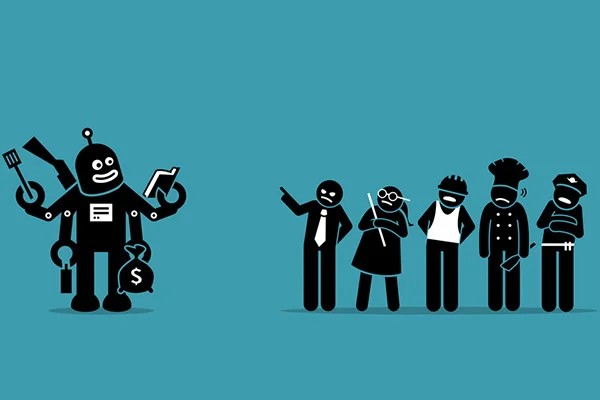
Automation vs. Future Job Market: How Will It Unfold
Automation is here to stay An automated warehouse in Hong Kong that runs 24/7 uses a swarm of robots driven by AI to help deliver groceries. Known as Autonomous Mobile Robots, or AMR, they operate on a tailored track laden with QR codes to track their movements. The data they collect aids in improving their efficiency over time. The more the robots work, the smarter they become. AI has helped meet modern consumers’ demands for fast delivery. The current Covid-19 pandemic has increased markets for automated logistics. Big players in e-commerce like Amazon and Alibaba already have a horde of AI-powered robots relentlessly doing their bidding. These Robots and computerized systems running them are subsets of a much bigger field of study: Artificial Intelligence. Automation is here to stay and thrive. There is no going back from a technology that is on a mission to transform how we interact with our daily tasks. Automation is everywhere, From warehouses to factories, from mobile phones to customer support, from cab services to transportation. You name a field, and Automation is already prevailing in it. Tesla and SpaceX CEO Elon Musk claimed that AI will be smarter than humans and will overtake by 2025. Although it sounds a bit exaggerated, the rate at which AI and Automation are galloping towards the future, such predictions are entirely dismissible. However, Elon Musk also described AI as an existential threat. There have been growing concerns about AI taking over human jobs. Is it a grave threat, or is it fear-mongering? As per a leading consulting firm, one in three US employees will hand over jobs to Artificial Intelligence by 2030. How Automation is affecting various industries Automation is a derivative of great industrial revolutions that changed the production and commodity landscape. There are four industrial revolutions, the current one being the fourth industrial revolution, also known as Industry 4.0 (To read more about Industry 4.0, refer to Introduction to Industry 4.0). Coming back to Automation and its effect on industries, it is safe to say that some sectors will be receiving a more significant impact than others. Let us have a quick look at such industries ready to embrace the automation juggernaut. Manufacturing: Probably the biggest receiver of change when it comes to Automation, the manufacturing industry is a fast-evolving domain that needs rapid advancements in Automation. Intelligent machines and robots have been in use in this industry for a decade already. The need for Automation in manufacturing is to enable error-proof operation, consistent production, negligible downtime, fewer human factors, and constant pace. In a world where consumer demand is growing, one must be super-efficient to meet those demands by supplying products to the market continuously. Transportation: Transportation is one of the first industries to be affected by the automation wave. Airplanes have already been using autopilots for decades. Self-driving cars are being increasingly tested and deployed on the road. Couple that with the Internet-of-Things (IoT), and we have a robust system of intelligent vehicles. Agriculture: With the world population touching 8 billion by the end of this decade, there is a dire necessity of producing the optimum amount of food to feed the people. As a result, the agricultural sector needs increased attention regarding automating food production, distribution, and supply. Logistics: As mentioned earlier in this blog, top companies like Amazon and Alibaba have upgraded logistics at the consumer level by employing robots, placing AI technologies to manage warehouses and delivery departments. Healthcare and Pharmaceuticals: With the advent of nanotechnology, robotics, and IoT, the healthcare and pharma sector has climbed the ladder and introduced some groundbreaking medical treatments. The field of gene research and genetic altering system employs nanobots to carry out tasks. Customer Relations: Remember when you enter a website, and a pop-up generates, eager to lend you support? Or how about when you have a complaint, and you interact with a customer care executive? Well, they are most likely chatbots with curated responses to address your queries and grievances. Many retail outlets in advanced nations are adopting cashier-less automated transaction desks. Automation will end with repetitive work, and it has started shaping future jobs. It is likely that soon a lot of the current jobs will no longer exist. It is even predicted that jobs like plumbers, car mechanics, barbers, and funeral directors are likely to be replaced by automated appliances, robots, and computers. Will Automation Take Over Jobs, Or Will It Improve Them? As seen from the thriving tech sector, there is no immediate threat to jobs with AI, but a more radical use of technology could destroy employment opportunities for millions. Automation has been around since the late 1800s, but with the rise of the digital revolution, we see it gain momentum and be applied to a wide range of sectors and services. We are already witnessing Automation and the use of robots taking over repetitive and mundane processes like manufacturing and sending information to factory floors. In the transport sector, most of the workforce is being replaced by technology. The financial industry has also begun losing jobs to computers as these can perform most of the jobs that have to be done. Eventually, it may result in a world full of unemployed people and loads of robots and intelligent systems. Yes, all those possibilities could turn out to be true. There are big movie franchises that show why this is not a good idea. According to a 2013 study on the probability of automated jobs predicted that bank workers, transportation and logistics workers, and clerical and administrative workers – many middle-class jobs – were at risk of being replaced by technology. But is that fear-mongering genuine? While Automation will indeed displace many jobs over the next 10 to 15 years, it won’t eliminate human employees at all but rather modify the job landscape by introducing new work opportunities. Rather than eliminating the drudgery of repetitive tasks, Automation will place people in control of an entirely different set of operations.
Read More
The Coronavirus shadow over outsourcing
The world has not witnessed a global recession since 2008. Experts suggest 2020 will be reminiscent of the great depression of the 1930s. The elites will lose money and the working class will lose jobs; the poor will lose lives. Such prediction and prophecies are quite rampant on the Internet and the media these days, and especially in social media. And it all revolves around the global pandemic: Coronavirus, precisely Covid-19. Let us skip past what COVID-19 is because if you are reading this, I am sure it has become a part & parcel of your daily life by now. With the world under lockdown, people wait with bated breath for the vaccine. Civil rules like social distancing, isolation, correct hygiene practices have been enforced. The public essential services are working with a limited workforce. The private companies have resorted to “work-from-home” aka WFH policy as this is the best bet that’ll keep them going. Coronavirus has exposed the vulnerability of the supply chain and pushed the IT industry in a complex rut. Most IT companies need IT service providers and the pandemic just “threw a monkey wrench in the wheel”. Almost every IT companies have mandated that their employees work from home. For now, video conferencing, cloud storage and collaboration tools are managing tasks seamlessly. Companies are leaving no stones unturned in making sure that their workers have the necessary tools and technologies to ensure speed, security, quality of services provided. In offshore locations, where much of the workforce is not familiar with the work-from-home scenario, is facing tactical and operational hassles such as getting laptops, setting up VPN, VDI, or Citrix access; seamless WiFi connectivity and ensuring product security. The IT industry has faced one of the worst crises ever in the face of coronavirus pandemic. Companies have shut down workplaces, stores, and processing plants. With the looming possibility of lockdown extensions, as the coronavirus spreads, many big companies have already charted out elaborate WFH plans. For example, TCS has already mandated that post- COVID-19, 75% of 4.5 lakh employees will permanently work from home. Although this is just a solution to keep the wheels rolling, the coronavirus pandemic has unleashed greater impacts incorporate business machine then what meets the eye. With economies closed, borders sealed, outsourcing has become a daunting task all of a sudden. Here is how the Covid-19 has affected IT industry and outsourcing: Continuation of business Let us be honest, most outsourcing business continuity plans were not designed to face a global pandemic and neither was ready to apply widespread work-from-home operations. In such trying time clients need to quickly assess the state of business continuity and take steps to address any holes or hassles. As of April, India was operating at around 80% of its pre-pandemic productivity with WFH fully enforced among 9 out of 10 employees. However, there are some companies repatriating services while some have opted for alternate delivery methods. It is expected that business continuation during a global disaster should be molded in a way that addresses such times. Productivity and Performance Coronavirus is already making impacts on productivity, either on a group or an individual. The sales department has witnessed it, particularly as their bonus targets are getting hampered due to uncertain situations. WFH is a sudden realization for every IT employee and churning daily productivity while maintaining performance is not consistent anymore. Another issue is with small and medium enterprises (SMEs) in India. They are the worst hit and cannot provide provisions for WFH for their employees Hence, either they have cut down their production and some have resorted to lay-offs. Effect on the Global supply chain Coronavirus pandemic has had a deep impact on logistics and supply chain. As of now, the cost of supplies from China has increased owing to expedited freight costs and paying premiums. Many industries in India are working out an alternative sourcing option, although chalking out and identifying an alternative supply system is not very easy. It is safe to say that, the more this pandemic extends, the more recovery time will be taken by the supply chain, which will affect all major countries. Closure of workplaces and facilities As the coronavirus kept on spreading at a rapid rate across the world, the first thing most governments did was enforcing lockdown. Absolute isolation. Of course, it is done with the noble intention of safeguarding citizens. Some governments have imposed long lockdown periods to let people familiarize themselves with it. However, this presents a problem for so many businesses as lockdown resulted in less footfall. Many of our clients from the States have reported a substantial drop in business due to closure: “It is great that our government is considering lockdown and stimulus package for corporations. However, when all our businesses collapse, who will provide these individuals with jobs? It is difficult enough to carry on any business in the state of California because of government oversight.” Said one of our clients with a worried voice. Work-From-Home hassles Although many companies have mandated WFH as they had full provisions and access to necessary tools, there a lot many others who are having a hard time providing their employees remote working facilities, mostly due to the lack of collaboration tools and interpersonal training. A report by a leading IT service management company suggests that 51% of the private companies in India do not have enough technology and resources to implement a full work-from-home strategy. While the non-IT firms struggle with decades-old systems, storage backup, and poor connectivity, the small and medium scale IT firms do not have adequate access to conferencing tools like Zoom or Skype or VPN and/or Citrix. Will, the corporate world resort to a new outsourcing model once this is over? If this is over? In case the pandemic stays for quite some time it is evident that the outsourcing landscape will witness a massive reshuffle. There might be an entirely new economic and world business model altogether. As of
Read More
Why and when should a company outsource software development
There are two proven aspects tech organizations rely on to survive and outpace their competitors in the market:Control, under which cost, resources, and capabilities are managed and Speed, which makes sure the product appears at the market. For these two ensure a steady flow of benefits and future bloom.But it is not a case of black and white but rather, multiple shades of grey as making a product is not the only task you have to tend to. The aspects of management, marketing, sales, analysis, employee management come into play. Being a jack of all trades is appreciable but not practical when you are running your own company. You need a helping hand and this is where outsourcing software development comes in. Software development outsourcing is a process followed by companies that hire a third-party software contractor to do the particular software related task that could have been done in-house. Developing a complete software application in-house asks for both money as well as time and to be honest, not everyone has an extended IT team. In these circumstances, tech companies turn to Software outsourcing companies.For the record, stats show that annual global revenue from the information technology field by outsourcing software development has been estimated to be around 60 billion $ as of 2019.Outsourcing software development projects help businesses achieve a higher economy of scale and let them focus on their core competency without spending a considerable amount of time and money.While you are considering outsourcing software development to a 3rd party, you are probably questioning about quality of work, the budget required, and the overall risk associated with outsourcing. This write-up intends to focus on the benefits of outsourcing software work. They are as follows: Access to a large pool of skilled resources Generally, outsourced companies have access to a larger talent pool of experienced and skilled specialists in the industry, owing to their years of collaboration with multiple firms from varied fields. Outsourcing helps you to find the right talents for the right project while shifting off your human-resource issues. Many companies also have an interviewing facility with an expert panel where you get an opportunity to select the expert candidates with the right skills and experience fit for your project. Most of the software application development companies maintain an extensive database of skilled employees. Adore flexibility Outsourcing software development allows for flexibility within business operations. Human resources are one such area which gets a breather, as you do not need to be attentive to recruiting and hiring procedures. Plus, you are worry-free about scaling your employees to change team size from one project to another project. Save on time & cost Outsourcing saves an immense amount of time spent on recruiting, training, and settling employees for in-house projects. And let us not kid ourselves, the biggest reason for people to outsource is to cut costs. Outsourced projects reduce development expenses by 60% – 70% less than in-house projects and help to reduce your workload. One of the important cost-saving factors is that you don’t have to perform upfront investment. Time-saving and cost reduction has always been the first choice of any business. And, outsourcing makes sure these issues are well addressed and taken care of. Perks of advanced technologies It is one of the prime reasons to hire a third party to develop a software application. Keeping up with modern technology space is a daunting task as it evolves day to day and keeps on introducing techs. By authorizing your software project requirements to a software application development company, you enable them to implement the latest technology for your project. These new trends and technologies are a result of such companies having years and years of experience with clients from various fields. Outsourcing has brought a new perspective to the workspace which encourages new technology put up by specialists who possess diverse technological expertise. Therefore, one need not worry about overhauls of ever-changing technology. Risk alleviation Outsourcing your software development task means you do not have to worry about risks associated with the development cost, resource allocation, on the failure of the development. As you hand over the responsibility to the 3rd party vendor, it becomes their prime responsibility to deliver the pre-defined outcomes for you. So outsourcing pretty much alleviates the risk. High-quality services While you go for outsourcing services, the outside firm guarantees high-quality services with zero downtime. And, they deliver quality results all the time. Outsourcing also opens up opportunities for up to-the-mark custom software solutions. The biggest benefits of outsourcing are high-grade services. This is the reason why more and more companies are selecting for outsourcing. Post-deployment services The team which worked on your software development is also capable of solving all the issues related to it. Hence, when faced with product complexities, the outsourced team will help you to fix it. A lot of outsourced companies have a 24×7 support team to assist you with issues about the concerned project. This ensures a hassle-free experience with great services. The service provider companies offer support, commitment, and maintenance throughout the project and also after completion of the project. Transparent work policy This case particularly helps when you have outsourced to a reputed company. When you are outsourcing, you might be clouded with concerns about privacy policy. Sharing an idea with an outside party is always a matter to ponder upon. But when working with a reputed organization, they will make sure full work transparency is maintained and all the compliance standards are adhered to. The catch is, you need to know which service provider to approach and the nature of engagement revolving around agreement papers and legal hassles. To obtain digital transformation and growth through innovation while reducing risks and increasing profit simultaneously, outsourcing software development is a great tool. It also helps businesses achieve competitive advantage without losing focus and efficiency. Your product remains in capable, trustworthy, professional hands, and you get to focus on running your business. It is a
Read More